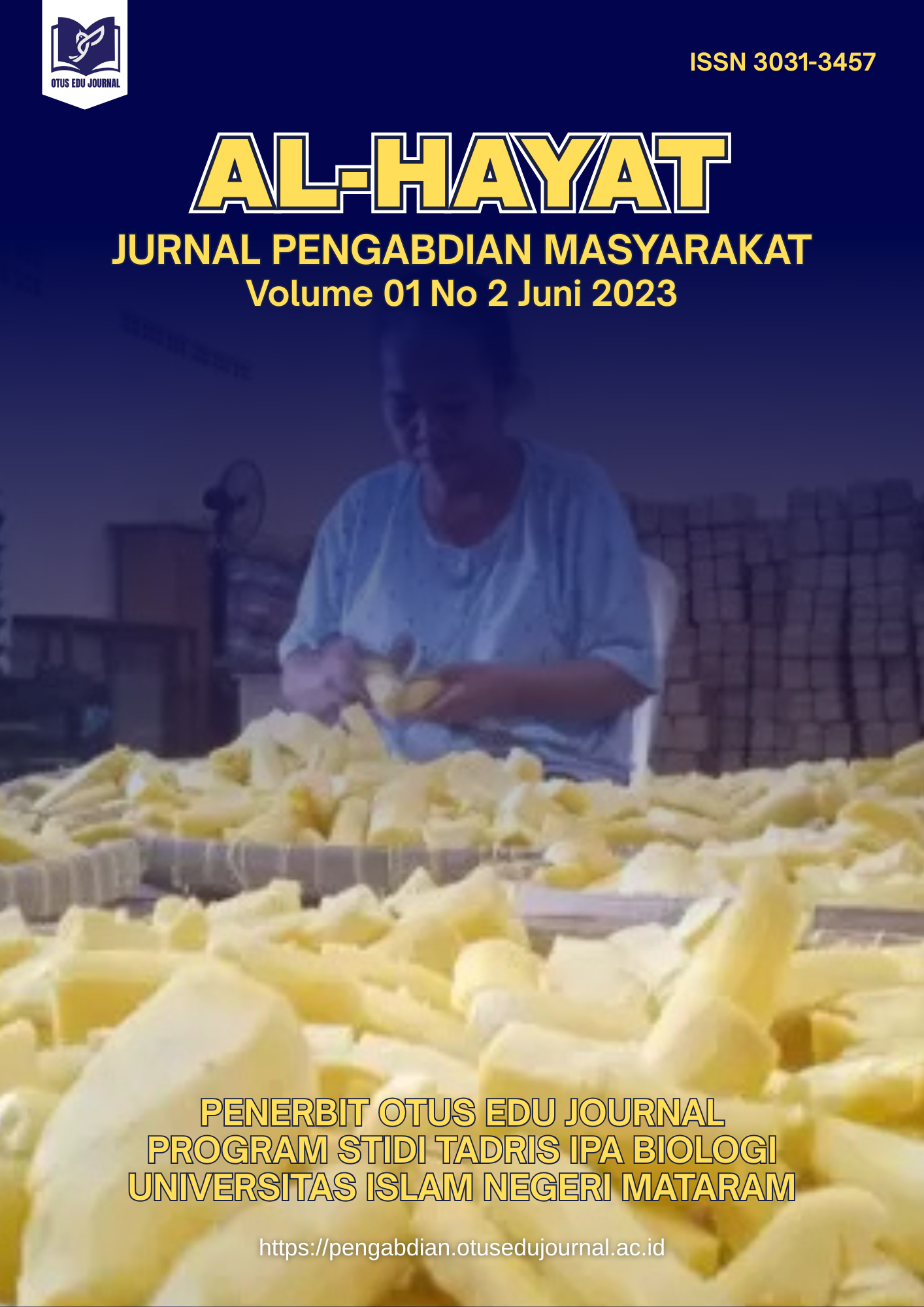
Penguatan Kapasistas Usaha Masyarakat Melalui Proses Fermentasi Pembuatan Tape Singkong (Manihot Utilissima) Di Dusun Limbungan Kecamatan Gunung Sari Lombok Barat
Downloads
References
Asnawi, M. (2013). Karakteristik tape ubi kayu (Manihot utilissima) melalui proses pematangan dengan penggunaan pengontrol suhu. Jurnal Bioproses Komoditas Tropis, 1(2), 56–66.
Barus, T., Chalista, S., & Lay, B. W. (2017). Identifikasi dan keragaman genetik bakteri asam laktat dari tapai singkong berdasarkan sekuen gen 16S rRNA. Biota: Jurnal Ilmiah Ilmu-Ilmu Hayati, 46–52.
Barus, T., & Wijaya, L. N. (2011). Mikrobiota dominan dan perannya dalam cita rasa tape singkong. Biota: Jurnal Ilmiah Ilmu-Ilmu Hayati, 354–561.
Broadbent, J. R., Barnes, M., Brennand, C., Strickland, M., Houck, K., Johnson, M. E., & Steele, J. L. (2002). Contribution of Lactococcus lactis cell envelope proteinase specificity to peptide accumulation and bitterness in reduced-fat cheddar cheese. Applied and Environmental Microbiology, 68(4), 1778–1785.
Creswell, J. W., & Creswell, J. D. (2017). Research design: Qualitative, quantitative, and mixed methods approaches. Sage Publications.
Dirayati, D., Gani, A., & Erlidawati, E. (2017). Pengaruh jenis singkong dan ragi terhadap kadar etanol tape singkong. JIPI (Jurnal IPA & Pembelajaran IPA), 1(1), 26–33.
Fahmi, N. (2014). Kadar glukosa, alkohol dan citarasa tape onggok berdasarkan lama fermentasi. Jurnal Pangan dan Gizi, 2(1).
Griana, T. P., & Kinasih, L. S. (2020). Potensi makanan fermentasi khas Indonesia sebagai imunomodulator. Potensi Makanan Fermentasi Khas Indonesia sebagai Imunomodulator, 6(1), 401–412.
Gultom, G. M. (2017). Komposisi mikroorganisme dan kimia tape singkong dan tape ketan yang diproduksi di daerah Bogor.
Hagedorn, S., & Kaphammer, B. (1994). Microbial biocatalysis in the generation of flavor and fragrance chemicals. Annual Review of Microbiology, 48(1), 773–800.
Harmayani, E., Santoso, U., & Gardjito, M. (2019). Makanan tradisional Indonesia Seri 1: Kelompok makanan fermentasi dan makanan yang populer di masyarakat (Vol. 1). UGM Press.
Hasanah, H., Jannah, A., & Fasya, A. G. (2012). Pengaruh lama fermentasi terhadap kadar alkohol tape singkong (Manihot utilissima Pohl). Alchemy, 2(1), 68–79.
Hidayah, N., & Basirun, B. (2021). Pengaruh jenis kemasan terhadap sifat organoleptik tape singkong. Nutriology: Jurnal Pangan, Gizi, Kesehatan, 2(1), 101–105.
Irawan, M. A. (2007). Glukosa & metabolisme energy. Sport Science Brief, 1(06).
Islami, R. (2018). Pembuatan ragi tape dan tape. Jurnal Penelitian dan Pengembangan Agrokompleks, 2(1).
Kanino, D. (2019). Pengaruh konsentrasi ragi pada pembuatan tape ketan. Jurnal Penelitian dan Pengembangan Agrokompleks, 64–74.
La Sinurat, R., Sumardi, S., & Salman, F. (2018). Karakteristik kefir susu sapi dengan inokulum ragi tape. Jurnal Ilmiah Peternakan Terpadu, 6(2), 111–116.
Manik, J. R., Kabeakan, N. T. M. B., Risnawati, R., Lubis, E., & Yusuf, M. (2021). Analisis usaha tape singkong (Manihot utilisima). Jurnal SOMASI (Sosial Humaniora Komunikasi), 2(1), 26–31.
McDonald, K., & Sun, D.-W. (1999). Predictive food microbiology for the meat industry: A review. International Journal of Food Microbiology, 52(1–2), 1–27.
Miles, M. B., Huberman, A. M., & Saldaña, J. (2014). Qualitative data analysis: A methods sourcebook. Sage Publications.
Moelyaningrum, A. D. (2012). Hazard analysis critical point (HACCP) pada produk tape singkong untuk meningkatkan keamanan pangan tradisional Indonesia. The Indonesian Journal of Health Science, 3(1), 41–49.
Mustianingsih, F. (2019). Pengaruh jenis ragi dan konsentrasi ragi terhadap kualitas tape singkong. Universitas Airlangga.
Nengsih, T. A., Kurniawan, F., & Prasaja, A. S. (2021). Analisis perbandingan keputusan membeli di pasar tradisional dan modern. Indonesian Journal of Islamic Economics and Business, 6(1), 17–31.
Nurjannah, N., & Nurhikmah, N. (2020). Pengaruh konsentrasi ragi dan lama fermentasi terhadap mutu tape singkong (Manihot esculenta Crantz). Jurnal Borneo Saintek, 3(2), 73–78.
Obilie, E. M., Tano-Debrah, K., & Amoa-Awua, W. K. (2003). Microbial modification of the texture of grated cassava during fermentation into Akyeke. International Journal of Food Microbiology, 89(2–3), 275–280.
Oktaviana, A. Y., Suherman, D., & Sulistyowati, E. (2015). Pengaruh ragi tape terhadap pH, bakteri asam laktat dan laktosa yogurt. Jurnal Sain Peternakan Indonesia, 10(1), 22–31.
Padonou, S. W., Nielsen, D. S., Hounhouigan, J. D., Thorsen, L., Nago, M. C., & Jakobsen, M. (2009). The microbiota of lafun, an African traditional cassava food product. International Journal of Food Microbiology, 133(1–2), 22–30.
Pawiroharsono, S. (2007). Potensi pengembangan industri dan bioekonomi berbasis makanan fermentasi tradisional. Jurnal Ilmu Kefarmasian Indonesia, 5(2), 85–91.
Prabowo, R. D. (2017). Kadar alkohol pada tape singkong dengan dosis ragi yang berbeda.
Rahmat, T., Faujiyyah, D., Fasha, A. R., Hadidawati, H., Yusuf, D., & Anareksa, H. S. (2023). Pengembangan keterampilan SDM melalui kewirausahaan digital: Optimalisasi gastrowisata tape singkong Desa Wargamekar. Journal of Community Service and Society Empowerment, 1(2), 119–128.
Rodas, A. M., Ferrer, S., & Pardo, I. (2003). 16S-ARDRA, a tool for identification of lactic acid bacteria isolated from grape must and wine. Systematic and Applied Microbiology, 26(3), 412–422.
Roziq, A., Hisamuddin, N., Wahyuni, N. I., & Purnamawati, I. (2015). Model pembiayaan salam pada petani singkong dan usaha kecil berbahan singkong di Kabupaten Jember. Jurnal Akuntansi Universitas Jember, 12(2), 43–57.
Sahratullah, D. S. D. J., & Zulkifli, L. (2017). Pengaruh konsentrasi ragi dan lama fermentasi terhadap kadar air, glukosa, dan organoleptik pada tape singkong. Jurnal Biologi Tropis.
Seumahu, C. A. (2005). Analisa dinamika populasi bakteri selama proses fermentasi nata de coco menggunakan amplified ribosomal DNA restriction analysis (ARDRA).
Somantri, G. R. (2005). Memahami metode kualitatif. Makara Human Behavior Studies in Asia, 9(2), 57–65.
Stahnke, L. H. (1994). Aroma components from dried sausages fermented with Staphylococcus xylosus. Meat Science, 38(1), 39–53.
Stake, R. E. (1995). The art of case study research. Sage Publications.
Stanbury, P. F., Whitaker, A., & Hall, S. J. (2013). Principles of fermentation technology. Elsevier.
Sulistiani, S., & Hidayat, I. (2020). Identifikasi molekuler bakteri asam laktat dari tempe dan tape berdasarkan sekuen gen 16S rRNA. Majalah Ilmiah Biologi BIOSFERA, 37(2), 69–77.
Surbakti, F., & Hasanah, U. (2019). Identifikasi dan karakterisasi bakteri asam laktat pada acar ketimun (Cucumis sativus L.) sebagai agensi probiotik. Jurnal Teknologi Pangan dan Kesehatan, 1(1), 31–37.
Susanto, A., Radwitya, E., & Muttaqin, K. (2017). Lama waktu fermentasi dan konsentrasi ragi pada pembuatan tepung tape singkong (Manihot utilissima) mengandung dekstrin serta aplikasinya pada pembuatan produk pangan. Jurnal Teknologi Pangan, 8(1), 82–92.
Yin, R. K. (2009). Case study research: Design and methods. Sage Publications.
Zahro, H. (2020). Proses produksi pia tape Tape Handayani 82 Bondowoso: Praktek kerja lapang.
Downloads
Published
Issue
Section
License
Copyright (c) 2025 Otus Edu Journal

This work is licensed under a Creative Commons Attribution-ShareAlike 4.0 International License.